
Artificial Intelligence and Machine Learning – English
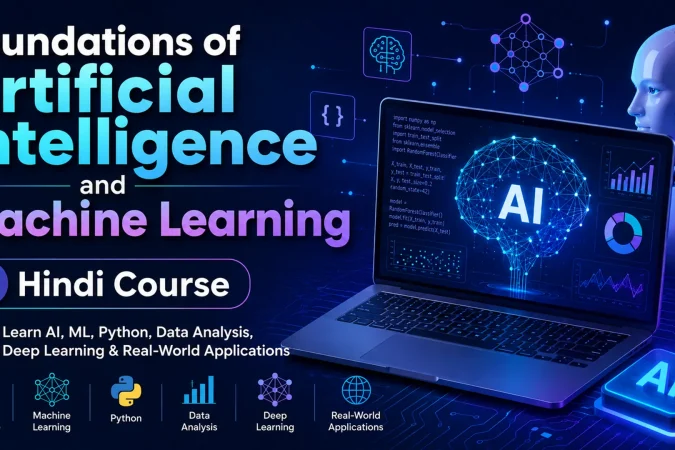
Foundations of Artificial Intelligence and Machine Learning – English
This course provides a structured introduction to Artificial Intelligence (AI), Machine Learning (ML), and Deep Learning, designed for learners who want to understand both the concepts and practical implementation of modern AI technologies.
Delivered in Hindi, the course starts with the fundamentals of AI and Machine Learning and gradually moves into Python programming, data preprocessing, exploratory data analysis, supervised and unsupervised learning, model evaluation, deep learning, and real-world AI applications.
Learners will also get practical exposure to tools and technologies such as Python, Google Colab, NumPy, Pandas, Matplotlib, Seaborn, TensorFlow and Keras, along with hands-on implementation of commonly used machine-learning algorithms.
What You Will Learn
- Fundamentals and evolution of Artificial Intelligence & Machine Learning
- Difference between AI, ML and Deep Learning
- Python programming for AI and ML
- Working with NumPy and Pandas
- Data cleaning, preprocessing, feature engineering and handling missing data
- Exploratory Data Analysis (EDA) and data visualization
- Machine Learning fundamentals and learning paradigms
- Supervised Learning: Linear Regression, Logistic Regression, KNN, Decision Trees, Random Forest and SVM
- Unsupervised Learning: K-Means, Hierarchical Clustering, DBSCAN and PCA
- Model evaluation using Accuracy, Precision, Recall, F1-Score, ROC/AUC and Cross Validation
- Hyperparameter tuning using Grid Search and Random Search
- Introduction to Neural Networks and Deep Learning
- Practical implementation using TensorFlow and Keras
- Applications of AI in Healthcare, Finance, Pharma and Education
- Basics of Recommendation Systems, Chatbots, NLP, Computer Vision, Cloud, APIs and Model Deployment
- 10 Sections
- 43 Lessons
- 10 Weeks
- Module 1: Introduction to AI & MLUnderstand AI, ML, Deep Learning, their evolution, applications, careers and responsible use.2
- Module 2: Python for AI & MLLearn Python basics, Colab, functions, NumPy and Pandas for AI, ML and data handling.8
- 2.12.1 Introduction to Python for AI & ML – English
- 2.22.2 Variables, Data Types & Operators- English
- 2.32.3 Control Structures: Loops & Conditions – English
- 2.42.4 Functions & Modules in Python – English
- 2.52.5 Introduction to NumPy & Pandas- English
- 2.62.6 Data Manipulation & Analysis with Pandas- English
- 2.72.7 Data Handling Basics with Pandas – English
- 2.82.8 Data Filtering & Selection – English
- Module 3: Data & Data PreprocessingPrepare data using encoding, feature engineering, missing values, scaling and outlier detection.9
- 3.13.1 Understanding Data Types & Categorical Data – English
- 3.23.2 Outlier Detection & Visualization – English
- 3.33.3 Feature Engineering & Data Encoding – English
- 3.43.4 Data Formatting & Type Conversion – English
- 3.53.5 String Manipulation- English
- 3.63.6 Handling Missing Values- English
- 3.73.7 Date Formatting & Extraction – English
- 3.83.8 Feature Scaling: Standard & MinMax Scaling – English
- 3.93.9 Data Decomposition & Aggregation – English
- Module 4: Exploratory Data Analysis (EDA)Explore, analyse and visualise data using statistics, correlations, Matplotlib and Seaborn.5
- Module 5: Machine Learning FundamentalsLearn how machines learn, key learning paradigms and the fundamentals of supervised learning.1
- Module 6: Supervised LearningLearn regression, classification, KNN, Decision Trees, Random Forest, SVM and practical modelling.6
- 6.16.1 Introduction to Supervised Learning & Classification- English
- 6.26.2 Regression Analysis: Concepts & Techniques- English
- 6.36.3 Regression Practical: Diabetes Dataset- English
- 6.46.4 Logistic Regression & Sigmoid Function- English
- 6.56.5 Logistic Regression Practical – English
- 6.66.6 Supervised Learning Algorithms Practical – English
- Module 7: Unsupervised LearningExplore clustering, K-Means, Hierarchical Clustering, DBSCAN, PCA and dimensionality reduction.6
- 7.17.1 Clustering Concepts & Unsupervised Learning Algorithms – English
- 7.27.2 Principal Component Analysis (PCA) Practical – English
- 7.37.3 K-Means Clustering & Distance Metrics- English
- 7.47.4 K-Means Clustering Implementation – English
- 7.57.5 Hierarchical Clustering – English
- 7.67.6 DBSCAN Practical – English
- Module 8: Model Evaluation & OptimizationEvaluate and improve ML models using key metrics, cross-validation and hyperparameter tuning.2
- Module 9: Introduction to Deep LearningLearn neural networks, activation functions, TensorFlow, Keras, backpropagation and ANN concepts.3
- Module 10: AI Applications & Deployment BasicsExplore AI applications, NLP, chatbots, computer1
Foundations of Artificial Intelligence and Machine Learning – English
This course provides a structured introduction to Artificial Intelligence (AI), Machine Learning (ML), and Deep Learning, designed for learners who want to understand both the concepts and practical implementation of modern AI technologies.
Delivered in Hindi, the course starts with the fundamentals of AI and Machine Learning and gradually moves into Python programming, data preprocessing, exploratory data analysis, supervised and unsupervised learning, model evaluation, deep learning, and real-world AI applications.
Learners will also get practical exposure to tools and technologies such as Python, Google Colab, NumPy, Pandas, Matplotlib, Seaborn, TensorFlow and Keras, along with hands-on implementation of commonly used machine-learning algorithms.
What You Will Learn
- Fundamentals and evolution of Artificial Intelligence & Machine Learning
- Difference between AI, ML and Deep Learning
- Python programming for AI and ML
- Working with NumPy and Pandas
- Data cleaning, preprocessing, feature engineering and handling missing data
- Exploratory Data Analysis (EDA) and data visualization
- Machine Learning fundamentals and learning paradigms
- Supervised Learning: Linear Regression, Logistic Regression, KNN, Decision Trees, Random Forest and SVM
- Unsupervised Learning: K-Means, Hierarchical Clustering, DBSCAN and PCA
- Model evaluation using Accuracy, Precision, Recall, F1-Score, ROC/AUC and Cross Validation
- Hyperparameter tuning using Grid Search and Random Search
- Introduction to Neural Networks and Deep Learning
- Practical implementation using TensorFlow and Keras
- Applications of AI in Healthcare, Finance, Pharma and Education
- Basics of Recommendation Systems, Chatbots, NLP, Computer Vision, Cloud, APIs and Model Deployment

Courses you might be interested in
-
DigiGuru-Paathsala
-
0 Lessons
-
DigiGuru-Paathsala
-
43 Lessons
-
DigiGuru-Paathsala
-
46 Lessons

-
DigiGuru-Paathsala
-
42 Lessons